Showing posts with label sailing. Show all posts

Thursday, June 9, 2016

Every picture in this blog

Stoke
Since we are in the depths of winter, some of you may be building your own Goat Island Skiff and dreaming big dreams of open water and fair winds.  Of salt on your lips, sun in your eyes, trailing a wake of phosphorescence through the seas of summer.  Fear not intrepid reader and intrepid builder-- our rock hurtles forward to the coming warm season.  Your sawdust on the floor will tomorrow be the dust of yesterday and you too will be sailing!

In the meantime, I have just realized I have quite a library of pictures that document the building of the Goat Island Skiff and my own subsequent adventures.  If you would like to peruse my photobank please see my Goat Island Skiff Amateur Style Gallery hosted on Picasa.

I hope it helps you, intrepid reader, to stave off the dark and the cold, and offers guidance for those first time boatbuilders.

Onwards!

Monday, May 30, 2016

FrankenBoom!

I built my boom originally as a temporary boom to get me on the water ASAP.  How does that old saying go?  "There is nothing so permanent as a temporary fix" or something like that.

Anyway, that temporary boom has been quite permanent on my Goat Island Skiff for the next two sailing seasons.  It has always been a little wobbly, especially since I use my sail loose-footed.  The tension along the foot slightly distorts the boom and I do lose some power.

I decided this winter to finally fix this boom.  Originally I was going to build a fancy shmancy box boom like many of my Goat Island Skiff compatriots.  I went over to Goose Bay Lumber and purchased a bunch of cedar for $63 and cut it into a bunch of strips only to realize it would be way wobbly. So then I got some Doug Fir for $15 and cut it up and put together another box boom, but I still wasnt happy with it.

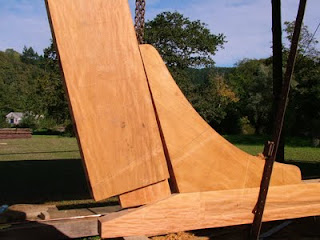
So screw it!  I decided to take my old boom and slap on one of those DF strips to the top of my boom, to compliment the lower horizontal piece.  I am proud of my laziness.  BEHOLD FRANKENBOOM!

All mocked up!

All glued up!

All sanded up!
So, this boom is definitely stiffer than the old temporary boom.  It is also heavier, but not by much.  I am happy with the results and will test it out this year on my Adventures-- of which there will be more than last year because there is a modicum amount of income flowing into my coffers.

That being said I have some very nice strips of western red cedar, no knots, 12 long, for sale.

On a side, the inrepid reader may also be interested in following my slow-poke restoration of my Beverly Dinghy.

Friday, May 27, 2016

Second sailing solo this time

 No pictures today folks.  I was too busy swimming or trying to stay dry.  What follows below I also posted at the Woodwork forum for Storer boat designs.  It sums up my second sail rather well.  A very interesting conversation is ensuing for those that are interested in handling the Goat Island Skiff.

**********

I have extensive racing experience in Blue Jays, Lasers, 420s, FJs, and recreational experience in Beverly dinghies and Beetle Cats. All marconi rigs except for the gaff Beetle Cat. I am an athletic 30yr old and weigh 150lbs.

The first time I went sailing in my GIS it was in a force 2- light breeze with my wife. The boat handled superbly.

I went sailing today for the second time in my boat, and I was by myself, and it was force 3- gentle breeze with some higher gusts. I got spanked by my GIS in ways I didnt even see coming, and Im surprised and a little humbled. I went sailing planning on a picnic as I cruised up and down the lake tweaking the rig. Instead, I went swimming.

So, as I headed out things were looking good. Its 65F (18C) and overcast, with a good breeze and slightly chopped water. I was un-reefed full sail, sitting on the rail and humming along, with a little bit of heal. A gust came up that I saw coming and I let out the sail a bit. This did not stop the boat from going over. I completely let go of the main and dumped it, but she still went over. Water poured over the gunwale, and that was it, I was in the drink and my flip-flops were floating away. That was fast. I swam around and clambered up on the daggerboard, no problems there, she came right up but obviously swamped. Balancing the boat was precarious. The nose was down, and I feared a breach in the forward compartment. I bailed her out with my 5 gallon bucket, and checked the forward compartment, it was dry.

I decided to reef. My sails are the stock Duckworks sails, with no reef points except the grommets along the luff and leach, its the full-batten idea.

In my personal opinion, the full batten idea is not conducive to reefing underway, especially with a sail this large. I was skeptical when I ordered it but decided to go with it anyways since it came with Miks recommendation and he looks so comfortable on his beautiful Beth. I found that that when situated in the bow of the boat the GIS is highly unstable due to its narrow beam in this area, and this was in only lightly chopped water. I tied off the "new" tack of the sail and then tied off the clew and re-hoisted the sail.

The full-batten sail with two reefing points cannot exert enough pressure along the boom to keep the sail folded up. Despite repeated attempts at re-tensioning the clew and tack and "new" outhauls I was not able to get enough tension along the "new" foot of the sail to keep it under the batten. As the chop increased, it became a more precarious situation to sit up in the bow fiddling with the tack. I attempted to keep the boat pointing in the wind, but with the large windage in the bow, it kept falling off the wind. A mizzen in this case would have helped immensely. Kudos to Clint and John.

Sailing a half-way reefed sail with a large pregnant foot billowing out I sailed close to shore and dropped anchor.

Dropping the rig I sat up in the bow to re-tension the new tack and clew, and found myself back in the water, as I capsized again, quite unexpectedly. As said before, the boat is unstable with no one else on board and the sole occupant up on the forward seat. This happened really quick.

I bailed the boat back out and made the tension along the reefed foot as tight as possible. As I headed back out to sail some more, the boat really moved along with the first reef. Exhilarating! However, the sail pulled back out of the batten, and I got the "pregnant" foot again. This is not conducive to pointing into the wind. At one point, I could not even tack, the boat kept falling off. I was almost forced onto some rocks, so I jibed around to remedy the situation. This was immensely frustrating, as you can imagine. Was it due to the rather flat head on the Duckworks sail?

Needless to say, I found that the GIS exhibits the following attributes:

*Difficult to de-power the sail in gusts. (is this an attribute of the balanced lug? I have zero experience with this)

*Unsteady when sole occupant is in the bow.

*The full-batten two-grommet reefing idea is either frustratingly difficult to accomplish successfully or only viable when launching reefed-- reefing underway with this fashion system is precarious at best.

*Boat has difficulty tacking through the wind when reefed.

Obviously I would like these remedied. My multi-day Maine coast trip is at risk unless I can figure these out. Im happy I didnt finish in March, or it would have been a very cold day indeed. My sail is going to get extra reef grommets immediately prior to any more sailing.

These are my first impressions of the GIS, but I would like to hear yours, or from anyone who can shed some light on this issue. The lug rig, as I understand, is a "reef early, reef often" rig, and I can attest to that. I would also like to know why I wasnt able to depower the sail to stop the capsize.


One thing I would like to emphasize:   This boat has 105 square feet of sail area.  Most boats this size have anywhere between 65-80 square feet.  This boat is overpowered, there is no doubt.  This makes it awesome in light airs, and its a necessity to reef when it gets heavy, especially when alone.  Just something to keep in mind.

Laser:          76 square feet of sail (crew of 1)
Beverly:       66 square feet of sail (crew of 1)
Walkabout:  80 square feet of sail
Mayfly16     91 square feet of sail
Beetle Cat:  100 square feet of sail (and 450lbs hull weight!)
FJ:               100 square feet of sail (crew of 2)
420:            140 square feet of sail (crew of 2)


Oh, she looks really pretty at anchor as viewed from the shore, and I continue to get "thumbs up " when driving on the highway.  

Sunday, May 22, 2016

Sonnet Sailing Dinghy

I have been motivated to do a review on the Sonnet for a number of reasons - (1) a new CNC kit is about to be launched (CKD Boats) (2) the Sonnet Sailing Association has a whole new breath of life and energy (3) Sonnets (along with Dabchicks and Tempos), are the brainchildren of a great dinghy designer, the late Jack Koper, an ex-Capetonian, and (4) I have personally built and owned two Dabchicks and one Sonnet (S269 - which I still own). Very close to home then!

It was these boats, built in 1965-73, that got me hooked on Sailing and Boating, and for which I owe my Dad a whole bunch - we learned carpentry and sailing at the same time back in those years. Dabchicks probably account for more accomplished sailors in SA than any other class to date I reckon!

Right-click for full-size - the current Sonnet Sailing Poster

?The Sonnet was designed in the early 70s - about 1971 as I recall. Jack designed the Dabchick first, the Tempo second, and the Sonnet 3rd as an in-between. Along wth the Dabby, it has become the most enduring design - and its a great credit to these designs that they live on after so many popoluar dinghies of that day have faded away. Sadly, the huge dinghy fleets of the 60s and 70s of Sharpies, Finns, Fireballs, Flying Dutchmen, Enterprises, Spearheads, Sprogs the odd Flying Fifteen etc - all gave way to Hobies, Lasers, Oppies, 09ers etc. Of the old-timers, Sonnets, Dabbies and Extras appear to survived best, and certainly in the Cape the Sonnet remains a very popular and active class. Its not an Olympic Class, but a great local class to put your hat in!

What makes the Sonnet so popular?
As a scow dinghy, it is flat, wide, stable and planes very easily. The beam makes it easy to get the ballast out wide, and the boat is easy to control and very forgiving. Ideal for strong wind, when dinghy sailing is most fun. Further, they are easy to handle (simple rig) - ideal trainers, but also very rewarding to experienced sailors in strong wind. A Sonnet in 25 knots on a broad reach is a truly unbeatable experience. I cant tell you the speed (before GPS) - but I can tell you the water jet that sprayed up through the centreboard casing flew clean over the transom, and only a small piece of boat would touch the water. Whilst many other dinghies compete well with them in lesser winds, the ultimate sense of speed belongs to the Sonnet! Well, to be fair - credit also to the Dabby (if you are small), the Tempo and Fireball (if you are a pro, and have a pro-crew as well). The Sonnet however, is the most acessible - easiest to build and own, and is also a great boat for single-handing. If you really want to learn to sail, learn to sail a monohull dinghy first. Its also the best way to learn single-handing - and the Sonnet would be the recommened boat every time, if you ask me.

Historically, most Sonnets were homebuilt - from Jack Kopers detailed plans (hand drawn) - using marine ply, meranti, and decent glue. It was inexpensive, not too difficult, but quite time consuming. No problem with this - but these days many people dont have the time or space to build there own boats from scratch - though I can vouch this is as rewarding as the sailing itself. In more recent times, Steven du Toit in Zeekoevlei has built a good few dozen Sonnets (very) professionally, and word now is that he is busy with a GRP version. However - professionally built boats are not exactly cheap! Dont ask me today - but I have seen pro-dinghies from R30-50k and some people say more . . . 

Do Sonnets have any drawbacks?
They dont point as well as pointy-boats in light winds. That said, they arent bad, and still cover the course faster than many equivalents. Plus, pointing high in light winds hardly compares with the adrenalin of a planing broad-reach! They arent Olympic classes, they also arent high-tech - but they are inexpensive, ideal club boats, and very rewarding.

Competition for Sonnets?
In South Africa, Sonnets Rule! At least in this class. Internationally, and for those seeking a modern high-performance kit boat, see also Dudley Dixs Paper Jet 14. See http://www.ckboats.com/, and http://www.dixdesign.com/.

Vital Statistics
  • Length Overall 4375 mm (about 143")
  • Beam 1525 mm (5)
  • Dry Weight of Hull only not < 75 Kgs
  • Mast length not > 5600 mm
Credits to the Sonnet Sailing Association for photos. For more info please see www.sonnetsailing.co.za.


My own Sonnet before FBYC longhaul earlier in 2010


Video Clip of this Sonnet sailing at Langebaan Lagoon, South Africa, in 2003

Friday, May 6, 2016

Side bar scales Fun Factor and Money Spent are totalled and explained

So on the left of the blog I have the "Fun Factor" and the "Money Spent" list.

I have totaled them up today in a completely unscientific fashion that will mystify some if they attempt to replicate my results, annoy others, or make others feel really really good about themselves.

First up, the Fun Factor.

Out of a possible of 240 points, building the Goat Island Skiff got 175 points, leaving it in the exclamation point (!) zone, but not as high as I would have liked to see it.  Overall the entire process was immensely satisfying, as it was emotional and frustrating.  On the whole since it averaged out in the 7! zone, it was fun.  But not FUN!  Thats OK.  Stuff doesnt have to be fun all the time to be rewarding, and the fun Im going to get out of this boat over the next few years will far overshadow any kind of frustration from the past year.  The learning curve aspect is also not included in the Fun Factor, and this is a shame, because I went into this project knowing absolutely nothing at all about boat building, and came out actually a lot more knowledgeable than I thought I would have.  This is a good thing.  Learning is good.  Look at some of my previous posts like this one to see how far Ive really come.  I mean, wow.  So in summary, the boat was fun to build, but it was fun like going to college was fun, the sex and the beer but also the exams and the papers and the thesis, but then feeling good afterwards!  So fun.

Second up, Money Spent.

Ok, this list is fraught with conservatism that does not reflect my situation in the least.  It was my honest attempt to track every penny I spent on this boat, but that went out the window fairly quickly.  I have compiled, therefor, a list of the materials as I mostly originally spent on them.  For instance, I got three deckplates for relatively cheap.  Well, they were cheap.  So they got upgraded to more expensive deckplates.  This upgrade is not reflected in the list.  There are other products like this also in place.

Im sorry about that, but the list in "Money Spent" is probably, by far, the LOWEST you could possibly spend, buying crappy deckplates and such.  Ive already upgraded much of the line in the boat, bought useless line, bought tons of hardware that mysteriously didnt get used, amongst other issues.  Therefor, a more realistic target for me, is the $3500+ number.

I will say:  The glue is accurate, the lumber is accurate, the paint, primer, varnish are accurate, as well as the sail (minus modifications).

So there you have it for comparison purposes on your own Goat Island Skiff project. 

Thursday, May 5, 2016

Sailing Camping Season Begins! Squam Lake

AHOY Intrepid reader!

I Am Zinea, Pterodactylus has risen again and spread her canvas-y wing(s) and sailed forth inaugurating a new summer of adventure!  Over the past weekend my trusty Goat Island Skiff and my lovely wife sallied forth under dark skies and sheets of downpouring rain in the company of Peteloaf, his spouse, and his Eureka Canoe.  Our destination was Bowman Island in Squam Lake where we intended to stay the weekend in quiet repose on these silky waters of this most beautiful of New Hampshire lakes.

The weather was beyond crappy, but that did not deter our heroes, whose hearts are made of Granite and whose souls sing the songs of silent years past, when Men were Men and the Rain trembled to hear our names whispered on the wind!

Anchors Aweigh!

The Group minus the Author with TWO Storer Boats adventuring!

An ODay Daysailor joined us as well-- two sailboats are better!
Goat, Flag, Loon... America is this.

I am a hero.  Subtract points for fender.

A quiet moment, I can add repetitive pictures all I want.

I am going to sum this trip up in a few sentences:  It rained.  I almost ran aground at high speed but saw the rocks loom out of the murky depths (actually the water is crystal clear) and hoisted the board up just in the nick of time.  The Squam Lakes Association does not staff their building on weekends apparently, so I didnt get a chart of the notoriously rocky waters.  It rained some more.  There was some more rain.  I got bit by a dog.  We brought lots of food and burned lots of wood.  There was some mist, and before we knew it, we were heading back home!

************************************************************

In other Goat Island Skiff news:


I have glassed the front end of my Goat with 4oz cloth.  I wish I did this last year.  If you look at the picture in full size, youll notice lots of white dots.  That is where rocks pounded the veneers inward and the paint from the bottom is in the well.  The dark areas in the plywood are water intrusion which occurred before I could get epoxy in them to seal them up.  My bow skid (not in plans) took some huge hits last year.  IF I could do it over I would have widened the two main skids (which are installed to plans on my GIS) widen them outwards just a bit and carried them much more forward, eliminated the bow skid, and made sure the first 3 feet of the boat had 4oz cloth for abrasion resistance.  This area gets abused on beaches and rocky shores, there is no way getting around it.  Might as well beef it up.

This is normal for me
This picture is my Quick Canoe after a capsize.  Basically, impossible to right and empty solo when in water above ones head without installed buoyancy-- either built in tanks or strapped in bags or foam.  Great way to cool off on a hot day though!

Tuesday, May 3, 2016

Westerly 22 Young Tiger


CMDR Denys Rayner 1943

Loch Nevis 7 August 1904
This image is from C.C.Lynams The Log of the Blue Dragon 1892-1904, London: A. H. Bullen 1907. The photo was taken in 1904 by Lynam of his family sailing in Loch Nevis - which is heaven in Gaelic. My seafaring mentor Denys Rayner, who read the book when at school, wrote that it infected him with "the sailing canker"
Denys Rayner shared Lynam’s preference for yachts in which the skipper removes ‘grease off a plate covered by the cold gravy of the mutton-chop’, keeps a cabin tidy and scrapes ice from its roof before dawn. Lynam was among the first to enjoy a kind of yachting that did not include much larger boats than the Blue Dragon - 25 foot, 2.2 tonnes - and did not rely on paid hands or wearing blazers and caps and racing. He pre-dated by 20 years Kenneth Grahams 1917 remark through Rattie about the pleasures of messing about in boats in The Wind in the Willows. I respect people who race around the world in sailing boats, but I find the idea of circumnavigating without stopping the opposite of how a small boat should be enjoyed. I have sailed across the Atlantic in a 22 footer but one of the tests of seamanship is finding and getting in and out of a multitude of different harbours and anchorages. Just as Lynam enthused Rayner, so Rayner infused me with the joys of visiting lots of places in small boats


25 August 1997 on the River Orwell at Sea Reach near Harwich on the UK east coast, of Rayners first design Robinetta launched in May 1937


Westerly 22


The 22 was offered with either a Bermudian or Gunter rig, but Rayner was a champion of the Gunter rig, citing both its ease of handling and what he felt were superior sailing characteristics.


Rayners friend Jack Hargreaves noted British Broadcaster, was an enthusiastic supporter of postwar family sailing and the boats then being designed in Britain for everyman". Here he is aboard Young Tiger.


Young Tiger setting out for the Americas


Here she is in Bequia, having been safely sailed across the Atlantic by two relatively inexperienced sailors, Simon Baddeley (Hargeaves stepson) and Sue Pulford. They first landed in Barbados, the crossing taking 29 days.


Years later Simon Baddelly was able to track down his beloved Young Tiger in 2007.


Denys Rayner had a rather distinguished career a Naval officer in the RNVR, fighting throughout the Battle of the Atlantic in WW2. But he is likely to be more for his achievements as a yacht designer. His life and service are well worth reading about and I found especially poignant the care he and his took of less fortunate souls after the war. Read the wiki.
His father was a racing yachtsman but at an early age Denys realized that he was more interested in cruising,
his imagination fired by C. C. Lymans The Log of the Blue Dragon. After a succession of small boats and cruises therein, Rayner in 1937 was able to design his own boat, Robinetta, and cruise the Western Highlands as had Lyman.
After the war Denys was able to return to his experiments with yacht design and adding manufacture. Like others in postwar Britain, he turned his attention to plywood and the design and building of small, trailerable craft with accommodations for a small family. Along with other designers, notably Robert Tucker, he helped enable a boom in small boat sailing which democratized the once elite sport by making it more accessible to the growing middle class. He also experiment with twin or bilge keels, allowing very shoal draft boats, a system discovered by Arthur Balfour.
In 1963 Rayner founded Westerly Marine and began building in GRP or fiberglass. The firms first design was the Westerly 22, based on his earlier Westcoaster. In 1965 a scheme was hatched. Young Simon Badderly, a family friend, and a companion, Sue Pulford, would sail a 22 to America, where Simon was to take a position after finishing his schooling. The boat was Young Tiger, the voyage a successful one which earned Simon the RCC Challenge Cup for a cruise in a small boat. Simon and Sue made the remarkably uneventful passage in 29 days, confirming Denys Rayners conviction that these were very seaworthy boats, indeed. There is a full account of that cruise, as reported in the pages of the Royal Cruising Clubs Journal for 1966 at 70.8%.
Westerly Marine went on to become at one time the largest boat building firms in Britain and have a very active owners group. The 22s continue to be quite popular, and can still be found in the UK and US, and probably further afield. A later Jack Laurent Giles design, the 26 Centaur, became the companies best selling model.

Much thanks to Simon Baddelly for the use of his material. Simon is soon off to Corfu!


Saturday, April 30, 2016

On the metaphorical road again heading for more small boat sailing adventures

The brotherhood of the travelling boots.

Its occurred to me that the hikers boots that I’m wearing have been to seven different countries so far, they’re good friends the two of them, get along well even though they’re almost twins. One of course is a lefty and the other a righty but even so they seem able to co operate and generally arrive wherever it is that they’re going at about the same time.

I’m on my way again, this time to Chile,  will arrive in Santiago in about 18 hours.
Right now I’m sitting in Auckland International airport, within a few metres of the Percival Gull aircraft that Jean Batten flew from England to New Zealand in 1936, setting a number of aviation records on the way.  That flight took 11 days and 45 minutes to cover a bit more than 14000 miles. 
I’m going to be travelling in an aircraft that barely resembles that tiny single engined spruce and canvas plane.  In fact it would be no real problem to fit the “Gull” into the cargo hold of the big Boeing that I’ll be imprisoned within for the 13 ½ hour flight across the Southern Pacific Ocean. We’ll be travelling at around 590 nautical miles per hour, how different it is from Jean in her little light plane t125 mph.  I bet she didn’t complain about the cabin service in her tiny cockpit .


Jean Battens Percival Gull airplane, as I write this Im sitting about 2metres away from the wingtip on the left of the picture, its a graceful little thing, but a real reminder of how much aviation has progressed since then, remember too that Jean Batten was with us until 1982, so most of this amazing progress has happened within the space of a long lifetime.

This trip I’m making is by the way the longest uninterrupted stretch of ocean that there is north of the five great capes about twice the distance that it is across the North Atlantic from USA to UK.

Which brings me to why I’m travelling.  I’m to meet up with friend and co teacher Howard Rice, and we’re going to be setting up for the big voyage of exploration that he is undertaking next southern summer.
That voyage, in a modified SCAMP, all of 11 ft 11 in long ( 3.575M ) will leave from Punta Arenas in the Straights of Magellan, carry him out through the channels and straights into the Pacific where he’ll turn left, and head south toward Cape Horn.
That latter is not necessarily the objective of the voyage, but rounding “The Horn” is a possibility.  The real purpose of the voyage is to explore the least populated and most rugged coastline on the planet,  riven with steep sided fjords, many with glaciers at their heads, backed by mountains, many un named as yet, and battered by the incessant gale force winds of the Roaring 40s this is an extraordinary place, and one which Howard will be exploring, and documenting.
There will be cameras on the boat, as well as within his support crew back at Punta Arenas, there is already some video “in the can” and the intention is to make a comprehensive video of the voyage, a video which will be available to anyone wishing to see the grandeur of the wildest place on the planet from the viewpoint of a small boat sailor.
There is more on the boat and the voyage in Howards Facebook page here
https://www.facebook.com/search/top/?q=howard%20rices


Yes it costs by the way, and if you’d like to support this, check out the directors website here. http://www.below40south.com.  There is also a lot of information on the voyage there.

  Any donations would be very gratefully received, we’re covered for the actual filming but the production costs will be significant and even a small amount would help to get what will be one of the great small boat adventures out where people can share it.

So I’m sitting here in Auckland airport with several hours to wait until the big silver bird roars down the runway and turns out eastward over the sea.
Its not boring, I’m in a quiet corner upstairs, this is one of the better airports that I travel through, and I’m alongside a glass wall where I can watch the people flow like a gently stirred anthill.  It’s the arrivals area just below me, and there are friends, parents, siblings and visitors arriving, it’s heart warming watching the enthusiasm and emotion with which they are being welcomed.

But I’m going the other way, I’ll be among that crowd downstairs in 20 days.


Friday, April 22, 2016

Sailing time 3

Ok, back to some sailing today with my Goat Island Skiff!  I had to take a hiatus the past few days to take care of some issues, but this afternoon I picked up my sail from Withum Sailmakers, who added some grommets along the original reef points, and a third reef, which will be the new first reef, half-way from the foot to the original first reef.  See picture.


This set up came highly recommended by the sailmaker, and my buddies over at the Storer Forum thread where we are discussing the Goats handling characteristics.  This will give me more options for reefing whether I am solo, or with a crewmember.

In addition, Ive adjusted my downhaul.  Previously, I had a downhaul that also went to the forward section of the boom and this was affecting my ability to dump power when a gust hit, and this contributed to me dumping the boat in Force 3 when I was solo.  It was a frustrating day, and in so small way my downhaul had a part to play.  This is what the downhaul looks like now.  Its still not what I want, because I lack the hardware, but its better than what it was, and it the difference was noticeable. 


Now there are some problems in this picture.  I need some more tension at the tack, and you can see the first grommet of the foot is pulled tight against the plastic zip-tie.  Either I need to tie down the entire foot, or re-enforce this area.  This force was created by the extra down force on the downhaul.  This extra force on the downhaul keeps the rig from swinging forward.  Though, as you can see in this pic of my going downwind, the downhaul is not parallel with the mast, because there is still not enough force, and by the end of the sail, the boom had inched forward.  More purchasing power on the downhaul will fix this.

OH! And here she is at anchor.  Pretty!

Tuesday, April 19, 2016

Golif the first all plastic sailing yacht


The 23ft Golif was built from 1962 by the Jouët works at Sartrouville. Jouët claim she was the first production small offshore cruiser to be entirely built in GRP, and she caused a stir on her introduction at the first Paris Boatshow in January 1962.

The unusual name comes from a famously ruthless, daring, and reportedly amorous 17th century French pirate, Louis Adhémar Timothée Le Golif, also known as “Borgnefesse”. Since his nickname means something like "one-eyed-arse", you would probably have been wise to address him, at least until you got to know him well, as Captain Golif.

Golif was designed by Jouet with one eye on the American market, where the management believed they could sell a lot of boats. They had probably been helped considerably in their objective by the earlier successful transatlantic voyages of Jean Lacombe, in a plywood Jouet Cap-Horn. Apparently the companys market research suggested that the Americans favoured rather more interior comfort than the European market was used to, and that stiffness under sail and transportability by road would be important qualities for US buyers. Some of the Golifs characteristic features, such as its panoramic cabin window, shoal draft, relatively light displacement and high ballast ratio, stem directly from these market-related requirements.

Even today, Golifs looks seem rather quirky, though the underwater hull shape and the rig appear conventional. At the time, however, Golifs rig was considered rather tall and narrow, and the aluminium mast was in those days quite an innovation on a small cruising yacht. The odd pinched shape of the coach roof seems to have been intended to maximise the width of the side decks, but without sacrificing headroom in the places below where you might want to stand. Thus, with perfect French logic, there is low headroom over bunks and seats, where you sit or lie down, but there is plenty of headroom over the central passage and galley area, where you stand or walk. As the Jouët company said, this deck was designed from the inside!

Unusually for such a small boat, Golif had a decent chart table at which you could comfortably sit and work while facing the direction of travel, as you might in a much larger yacht. This was achieved by making the chart table swing down from the cabin deckhead right in the centre of the boat. Another innovation was a hinged and sliding hatch (visible in the colour photo of a Golif recently for sale in France)

Some versions of the Golif were delivered with an optional deeper keel for racing performance. These boats were excellent performers in offshore races and won many prizes, but it was a perfectly standard Golif that achieved the greatest fame for the class. In 1964, Jean Lacombe who had been Frances sole entrant in the 1960 Observer Singlehanded Transatlantic Race (OSTAR), returned to repeat the feat in a Golif, once again the smallest boat in the competition. This was the year of Eric Tabarlys first triumph, so Lacombes achievement was rather overshadowed by the acclaim and fanfares garnered by the winner. Nevertheless, Lacombes Golif took joint pride of place, alongside Tabarlys Pen Duick II at the centre of the 1965 Paris Boat show. (see photo)

There are varying estimates of the total number of Golifs built by Jouet and also by the Dubigeon yard in Normandy. The total number certainly comes to over 1000.


Jouët Golif
LOA: 6.50m
LWL: 5.92m
Beam: 2.22m
Draft: 0.96m
Displacement: 1200Kg
Ballast: 480Kg (cast iron)
Sail area: 23.2sqm

Many thanks to the French Golif owners website for all the b&w images and much of the information used in preparing this post. Colour photo of a Golif recently for sale in France from an advertisement on www.leboncoin.fr

A scanned copy of the original 1963 Jouet Golif sales brochure is available in .pdf format from Yacht Brochures.co.uk

Wednesday, April 13, 2016

Rigging woes and possible solutions

Again, if youre a regular reader or are interested in the handling and rigging characteristics of the Goat Island Skiff, and some problems I have been encountering, I strongly urge you to read this thread.

Also, in order to solve some of my problems I have decided to go loose footed with my sail instead of laced.  I have an album set up with before and after pics for those that would like to peruse them.  They highlight some of the problems Ive been having with the rigging, and how I hope loose footed will help.

There are other great threads too, such as this one.

Tomorrow will be the loose footed experiment day, stay tuned!

Monday, April 11, 2016

BETH Sailing Canoe

Robert Hoffman in Poland is a 1001 Boats follower and having read his own blog I asked if we could feature his delightful Sailing Canoe "Beth".


Designed by Michael Storer


Robert tells the story as follows, "Even before 2000, my brother found on the internet an interesting and simple in construction, sailing canoe modeled on traditional sailing canoes from 1870, American sharpies and famous American boat designer Phil Bolgers influences. A boat so pleased him that soon he made contact with the Australian designer Michael Storer and bought the plans. He was going to build it, but life turned out differently. Ever since my brother showed me BETHs building plans, she liked at first sight to me also - with its elegance and simplicity, as well as the expected features of the sailing.


A few years later my brother gave me BETHs plans to build. In April 2009, build began my sailing canoe in my tiny garage. The whole time I was by Internet in contact with Michael Storer, who on his forum and private gave me some useful advices. The boat was a really inexpensive and simple to build. Building was possible singlehanded and using a very modest set of tools. After several months, just before the onset of cold weather definitive construction was interrupted for the winter, and then resumed in April 2010.


My BETH Sailing canoe was launched May 28, 2010 in Gdansk (Gorki Zachodnie), where it took part in the Raid Poland 2010. She obtained the name "YuanFen" (Chinese - a force that brings people together) but the variable and uncertain weather and the experience and common sense meant that BETH “YuanFen” did not emerge over the Gulf of Gdansk.

From June 2010 to the end of August Ihave tested it on a little lake (Jezioro Dziekanowskie) near my house. She proved a fast boat and pleasant sailing. Is the boat for the experienced sailor, but the hull is relatively more stable than the other canoe hulls. She is easy to maneuver on land it singlehanded and easy for trailering and roofracking. She draws attention to its characteristic appearance and speed - she is the attraction of the waters which she will be on.

I am grateful to the designer Michael Strorer for such a beautiful design and for his advice and comments, which I gladly gave during construction, as well as my brother, for showing me BETH and transmission plans, including the right to build her.

I have serious plans to continue to use my sailing canoe BETH "YuanFen" - I intend to test it to a larger water body, and prepare for the trip (in 2012) from the Poland to Danish island Bornholm - about 70 nm open Baltic Sea. This requires preparation and common sense - good and stable weather is essential. I believe this is possible, but always keep in mind that this is just a tiny canoe.
"


Beth has a delightful simplicity and elegance, a perfect boat for getting out and enjoying being on the water, equally as many intrepid Victorian sailors were to demonstrate these small craft can make remarkable voyages. We look forward to hearing more on Roberts open water voyage on the Baltic.

Saturday, April 2, 2016

Hazey Summer Daze continues

Theres a double meaning in the title for the intrepid reader...

Monday, March 28, 2016

Alert

Another fantastic boat built by Will Sterling and his team down in Tavistock the West country lugger Alert.


Will explains "Alert is a Westcountry Smuggling lugger of circa 1835. At 15 tons she was our first heavy displacement new build. She was drawn after a part time MA in Maritime History at Exeter University during which the principal area of study was the design and construction of Revenue Cutters between 1770 and 1850".


Wills initial interest in maritime history came through Admiral Sir Robert Barlow of Plymouth, a very great Grandfather, who during his early naval career ccampaigned against the Westcountry smugglers with success. His daughter married William Nelson, Horatios elder brother.


Alert sailed on her maiden voyage to Iceland with Will and crew before returning to Plymouth where she is moored having been sold to a local man. The Alert build received an award from the South West Maritime History Society for exceptional boatbuilding and research.


Monday, March 21, 2016

Pen Duick II and The French Sailing Revolution

Back in the early 1960s France was still recovering from a war which had left many of its cities in ruins, its businesses broke and its economy on the rocks. To make matters worse there were deep divisions in French politics and the overthrow of the government in a military coup detat seemed a possibility at times.

In this climate its not surprising that yachting was regarded as a minority activity. There were, anyway, few facilities for yachts except in places where foreign-owned boats came to visit. The idea of owning and sailing a yacht for pleasure would have seemed elitist, expensive, and impractical for the ordinary French man or woman.

If you sailed to any French harbour in the late 1950s or early 60s you would have seen no more than a handful of private yachts, most of them old and somewhat tatty. In Britain, yachting and offshore yacht racing was already booming, and British designers like Laurent Giles, Robert Clark, Peter Brett, Arthur Robb and C E Nicholson had become world famous for their robust and capable ocean racers and cruisers.

Then a Frenchman with a French boat won a famous French victory – and everything changed.

In 1964 Eric Tabarly with his remarkable ketch Pen Duick II (thanks to Remi Jouan for the above image) laid the foundations for the extraordinary boom in French yachting which has resulted, more than 40 years later, in France having a 37% share of the global market for sailing yachts, most of the worlds biggest yacht building businesses, many of the worlds most famous and successful yacht designers, a domestic leisure boat market of 8 million users - the second largest leisure boat market in the world after the USA - and a virtual monopoly on long-distance short-handed ocean racing superstars.

Eric Tabarly was a tough, handsome sailor, an officer in the French Navy, who was passionate about sailing and utterly determined to win the Singlehanded Transatlantic Race. Nowadays we think of “Le Transat” and other long distance races as French, but the original race in 1962 was an all-British idea, conceived by a British eccentric, Blondie Hasler, organised by the Royal Western Yacht Club, and sponsored by the Observer newspaper.

Francis Chichester had won the first race in 1960, and was favourite to win again. His yacht was a 40 foot Robert Clark ocean racer, solidly built and carrying a big cutter rig. Tabarly, an unknown in international yachting circles at the time, conceived a 44 foot purpose-built, light displacement ketch. She was built, simply but strongly in plywood with a double chined hull, and her rig was designed for power combined with good helm balance and ease of sail handling. However, no one had raced singlehanded in such a big boat before and most experts gave him little chance of finishing.

Tabarly stamped his authority on the race at an early stage. His determination to win was evident from the moment he launched an 900 sq ft spinnaker soon after the start (to the surprise of all who thought you needed a full crew for that kind of sail) and opened a huge lead over the rest of the fleet in the first couple of days.

He was handicapped by a number of gear failures. His self-steering gear jammed, forcing him to steer the boat by hand for many more hours than he had expected, his cheap alarm clock stopped working, making it difficult for him to keep to a sensible rest schedule, and his log rotor was bitten off by a dolphin. In mid-Atlantic his jib halyard block broke and he had to climb the mast to replace it. Nevertheless, Pen Duick II crossed the finishing line first in a record time of 27 days 3 hours, almost a full 3 days ahead of the pre-race favourite, Francis Chichester. Another Frenchman, Jean Lacombe finished in 9th place in his tiny GRP “Golif”. (More on this boat in a forthcoming post). (photo: Pen Duick II nears the finish line of the 1964 OSTAR: AFP/Getty Images)

France cheered the new hero. He was immediately awarded the Legion dHonneur and returned home with Lacombe to a rapturous reception. Suddenly the French media and the French people took an unprecedented interest in yachting, new small yacht designs appeared from new French designers and new factories, money was found to build sailing schools and marinas, and France set a course towards domination of the European yachting industry.

In the next Observer Singlehanded Transatlantic race, in 1968, there were no less than 9 French entries, then 13 in 1972 and 31 in 1976. In 1984 out of the top 10 finishers, 8 were French. These days the “Transat”, as the race is now called, is dominated by French sailors, French boats, and French sponsors.

After the 1964 victory, Pen Duick had a busy and wearing life as an ocean racer taking part in many fully crewed races, during which Tabarly trained a formidable number of apprentices such as Alain Colas, Marc Pajot, Olivier de Kersauson, and others. These graduates of his informal sailing college became the next generation of great French ocean yachtsmen. Eventually Pen Duick was sold to the Ecole Nationale de la Voile at Quiberon, but after a short time, and a serious grounding, she was taken out of service and laid up ashore at the school gates. It wasnt until 1993 that a campaign to restore this famous boat was mounted, and with financial support from the government, the French Navy, the regional council of Brittany and others, she was restored to perfect condition. (colour photo above with permission of Remi Jouan)

Pen Duick II is now based at Quiberon and is used as a busy training vessel during the summer months and an occasional exhibit at the Cite de la Voile Eric Tabarly centre at Lorient in Brittany.

Pen Duick II

Designer : Gilles Costantini, Eric Tabarly

Built 1964 by Costantini at La Trinité, Brittany.

LOA : 13 m 60

LWL : 10 m

Displacement : 6.5 Tons

Beam : 3 m 40

Draft : 2 m 20

Rig : Ketch

Sail area : 60 m2

Construction : Hard chine plywood